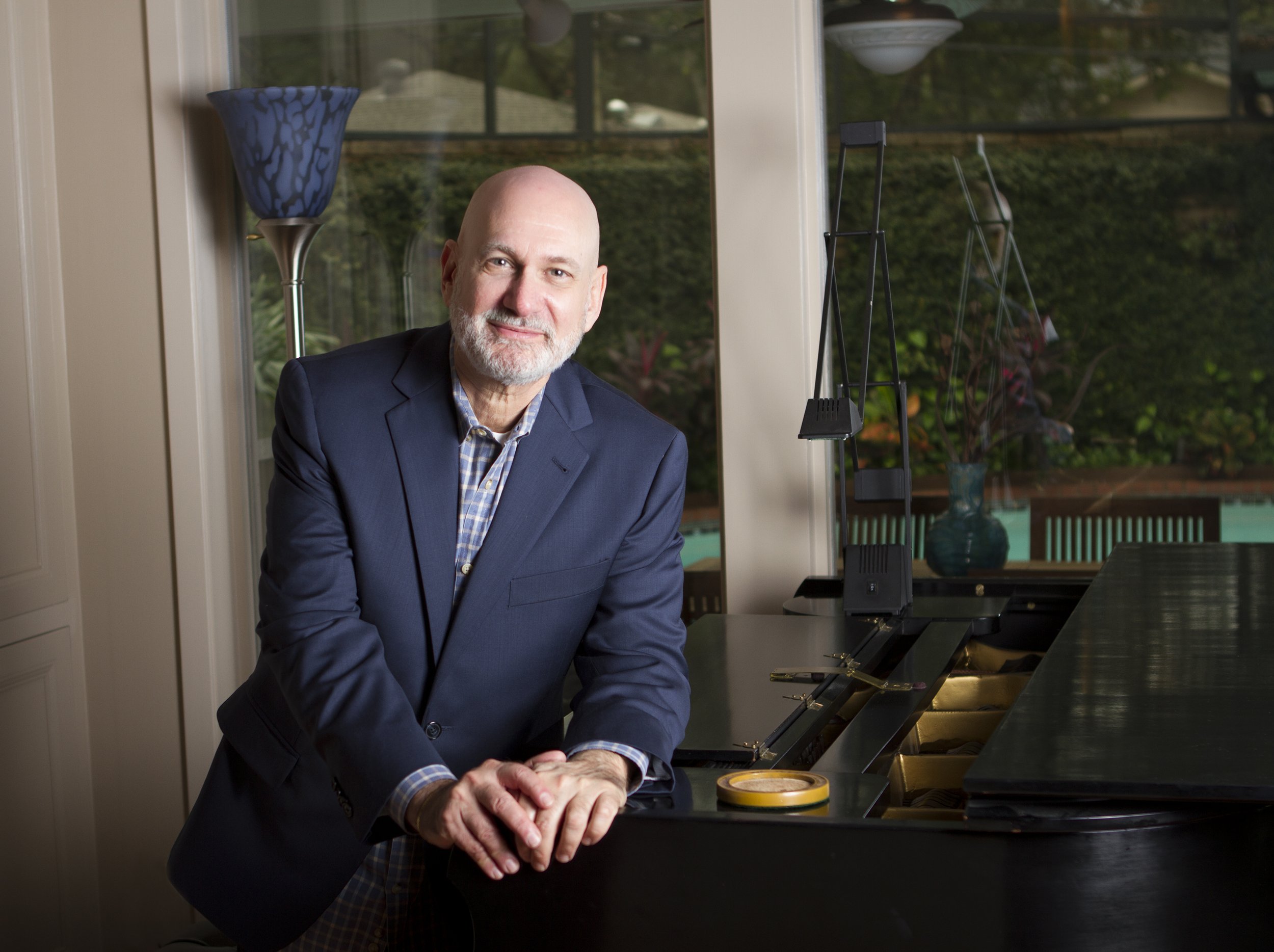
Professor Howard Pollack
Pianist and musicologist Howard Pollack is Beth Madison Professor of Music at the University of Houston, where he has taught since 1987. He received his BA & MA in music history at the University of Michigan, and his PhD in musicology at Cornell University.
The author of eight highly acclaimed biographies, Pollack further has lectured and given lecture-recitals at colleges and arts organizations in Argentina, Australia, Brazil, the Czech Republic, England, Germany, Italy, Mexico, and across the United States, and has appeared in film documentaries and on such American radio shows as Morning Edition, All Things Considered, the Voice of America, and Fresh Air as well as on British, Australian, New Zealand, and German radio.
Among other grants and awards, he has received two fellowships from the National Endowment for the Humanities, a Lifetime Achievement Award from the Society for American Music, and five awards from the American Society of Composers, Authors, and Publishers.
Presentations
How Jewish Was George Gershwin?
From the streets of New York's Lower East Side to the Broadway stage and the concert hall, George Gershwin absorbed an extraordinary range of musical influences. But what role did his Jewish heritage play in shaping his music? Through live and recorded examples, this lively presentation explores Gershwin's immigrant roots and his connections with New York's Jewish community, including the vibrant world of the Yiddish theatre and the Thomashefsky family. Along the way, we will discover how Yiddish song, synagogue music, and the broader experience of Jewish immigrant life contributed to the distinctive musical language of works ranging from his popular songs and Broadway musicals to Porgy and Bess.
From Bloch to Bernstein: Jewish Voices in America’s Classical Music
What, if anything, makes music “Jewish”? Through recordings and engaging commentary, this lecture explores that fascinating question through the lives and music of Ernest Bloch, George Gershwin, Aaron Copland, Marc Blitzstein, Arnold Schoenberg, and Leonard Bernstein. Discover how Bloch evoked biblical spirituality, Gershwin wove echoes of Yiddish song and synagogue chant into his distinctly American style, Copland drew on the sounds of Eastern European Jewish folk music in Vitebsk, Blitzstein brought social activism to the musical stage in The Cradle Will Rock, Schoenberg confronted the Holocaust in A Survivor from Warsaw, and Bernstein celebrated Jewish assimilation in the delightfully comic “I Am Easily Assimilated” from Candide.
Leaving Home: Jewish Immigration and the American Musical
During the golden age of Broadway, many of America's greatest musicals were created by Jewish immigrants or, more often, by the children of Jewish immigrants. Through recordings and engaging commentary, this lecture explores how the immigrant experience—leaving home, adapting to a new culture, confronting prejudice, and imagining a better future—imprinted itself on the American musical, often in subtle and unexpected ways. Through memorable scenes and songs from Show Boat, Porgy and Bess, Street Scene, Oklahoma!, West Side Story, Candide, Flower Drum Song, and Fiddler on the Roof, we will discover how these works transformed the hopes, anxieties, and aspirations of immigrant America into enduring musical drama.
Ernest Bloch: The Composer Who Gave Jewish Music a Modern Voice
How did a Swiss composer become the twentieth century’s foremost musical voice of Jewish identity? This lecture follows Ernest Bloch (1880–1959) from his childhood in Geneva and his experiences as a Jew in Switzerland to his emigration to the United States and his emergence as one of America's leading composers and composition teachers. Along the way, we will explore the inspiration behind his celebrated “Jewish Cycle,” hear recorded excerpts from Schelomo, Baal Shem, and the Sacred Service, and discover how Bloch created a powerful musical language that continues to inspire audiences worldwide as the 150th anniversary of his birth approaches in 2030.
Testimonial
Professor Howard Pollack’s presentation linking Broadway show tunes (and other familiar music) to Jewish liturgy was engaging, informative and fun. The audience was delighted every time Howard played one of many favorite songs and then showed how historical Jewish liturgy provided the rhythm. He was delightful to work with. Everyone enjoyed his presentation.
– Deborah Chapman Goldstein, Director of Planned Giving & Endowment, Jewish Federation of Northeastern New York
Critical praise for Pollack’s books
Aaron Copland: The Life and Work of an Uncommon Man (1999)
“the definitive study of Aaron Copland's life and work, no doubt for a long time to come” (New York Times)
“a valuable model of what biography can and probably should be” (Kirkus Review)
George Gershwin: His Life and Work (2006)
“a monument to all that we presently know about Gershwin as both man and musician” (Journal of the Society for American Music)
“endlessly fascinating” (New York Times)
“a gripping read” (Charleston News and Courier)
“some of the best musical analysis you're likely to find anywhere” (Toronto Globe and Mail).
Marc Blitzstein: His Life, His Work, His World (2012)
“magisterial and revelatory” (Notes)
“a momentous achievement” (Choice)
“a magnificent, richly detailed study” (Journal of the American Musicological Society)
The Ballad of John Latouche: An American Lyricist’s Life and Work (2017)
“a scholarly tour-de-force” (Notes)
Samuel Barber: His Life and Legacy (2023).
“the place to begin any inquiry into Barber’s music” (Notes)
“Because Mr. Pollack is a master of writing about artistic creation without forbidding jargon, his explanations of Barber’s music are just as arresting as the biographical passages” (Wall Street Journal)
“This splendid biography and fitting tribute to a distinguished American composer is expansive in detail, and I cannot sing its praises loud enough; kudos to Howard Pollack for this remarkable achievement” (MusicWeb International)
“For listeners, the volume represents a wealth of well-worded invitations to listen to familiar music with fresh ears. And for all of us, it exemplifies the humanizing touch that has for so long characterized Pollack’s work as the biographer of American music” (Journal for the Society of American Music)