Professor Roger Berkowitz
Roger Berkowitz is Founder and Academic Director of the Hannah Arendt Center for Politics and Humanities and Professor of Politics, Philosophy, and Human Rights at Bard College. He is the author of A World We Share: Hannah Arendt and the Power of Friendship in a Broken World (Yale University Press, 2026) and The Gift of Science: Leibniz and the Modern Legal Tradition (Harvard University Press). For the Library of America he has edited collections On Totalitarianism and On Civil Disobedience.
Berkowitz writes the weekly Amor Mundi newsletter, hosts the podcast Reading Hannah Arendt, and organizes the annual Arendt Forum, bringing together leading thinkers to discuss urgent political and cultural questions. He is the recipient of the 2019 Hannah Arendt Prize for Political Thought and the 2024 Compassion Prize. His work explores the importance of thinking, judgment, friendship, and political freedom in contemporary life.
Presentation
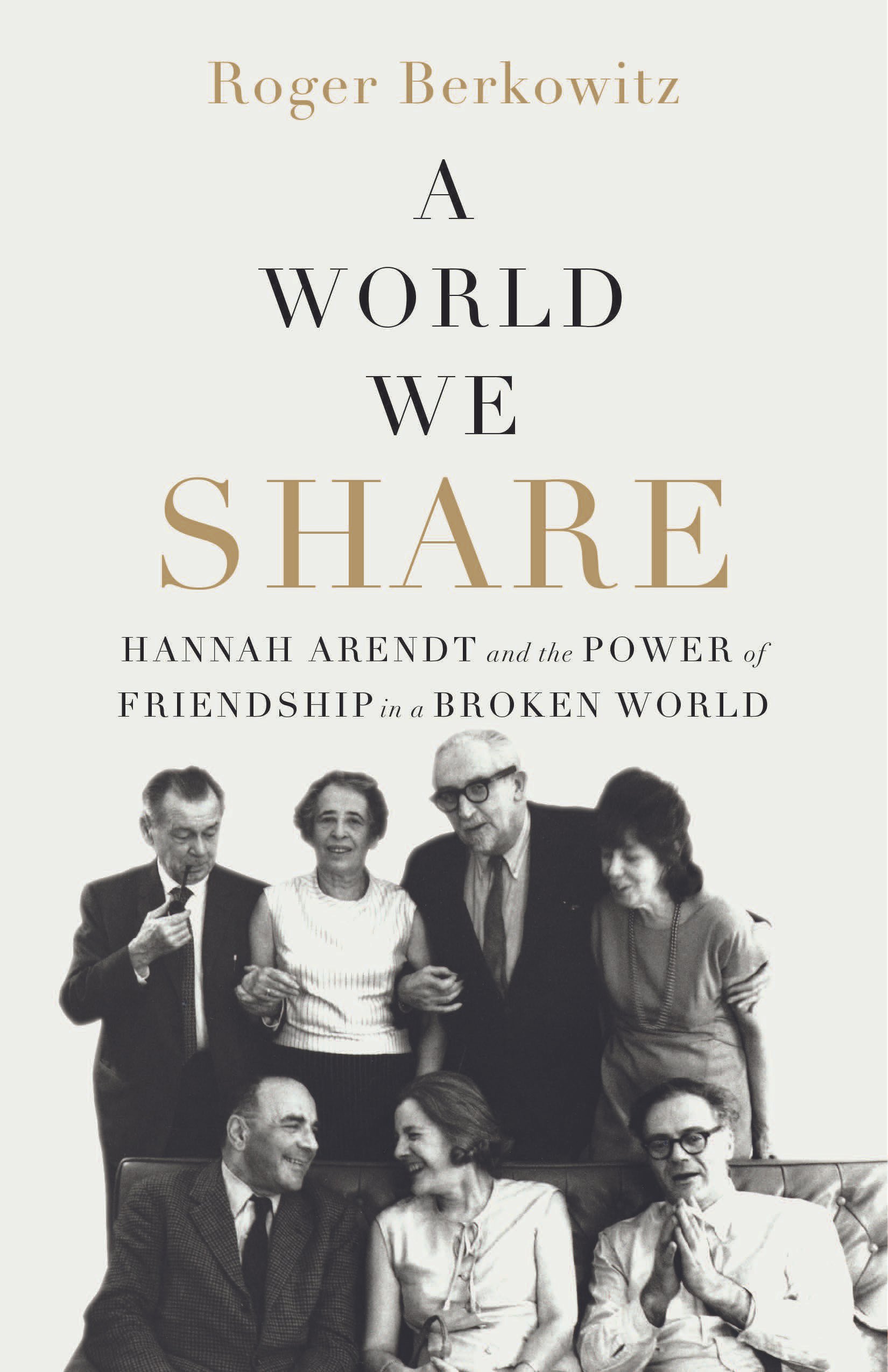
A World We Share
In October, 2023—one week after the terrorist attacks of Oct. 7— I gave a talk on friendship and politics. I began from Hannah Arendt’s provocative idea that friendship across disagreement is the foundation of political life.
In the wake of that violence, I found myself asking: What are the limits of friendship? Could a Gazan and an Israeli be friends? Can we remain friends with those whose politics we reject and whose truths we find intolerable?
A World We Share grew out of that question.
This presentation tells the story of Hannah Arendt's friendships with figures like Mary McCarthy, Gershom Scholem, and even Martin Heidegger. It shows how Arendt's genius for friendship shaped both her life and her politics.
For Arendt, friendship is a space where people speak honestly, disagree openly, and still remain connected—a small world between people that becomes a model for political life.
I argue our political crisis is not a crisis of truth, but a crisis of friendship. In an age of loneliness, polarization, and moral certainty, we treat disagreement as a reason for exclusion. Arendt offers a different path: politics depends not on shared truth, but on our willingness to nurture friendships across deep differences. She believed that a human being is far more valuable than their opinions.
Our communities are having hard times talking to each other. This presentation can help.
First, can a liberal and a conservative be friends? How? Why would they want to? What progress could we make when we see the other as a friend and not as an enemy?
What can Arendt's understanding of friendship offer as we confront the Israeli-Palestinian conflict. I offer a language that allows disagreement about Israel and Gaza without collapsing the possibility of community and progress.
My presentation and book are about friendship and Hannah Arendt: It is about the power of friendship to heal our broken world.
A World We Share Hannah Arendt and the Power of Friendship in a Broken World
Testimonials
Thank you for sharing the magnificent Sukkot presentation. I was enchanted by its message about the restorative powers of friendship, and I was dazzled by how you wove ideas about Arendt with some of the traditions surrounding Sukkot. Your ability to explain complex ideas so as to render them with greater clarity is just marvelous, a talent that also characterizes much of Arendt's work. Bravo…it was a masterwork.
— Steve Maslow, CFO Art Discovery
Thank you so much for joining us on Shabbat. Your words are truly inspiring. I must tell you that the feedback has been extremely positive and people are very excited about your book. In a world that has more challenges than we’ve seen in recent years, your message is more important than ever.
—Wende Jager-Hyman, Temple Beth Sholom Roslyn, NY
Roger Berkowitz's presentation was excellent. I found the 3 characteristics of friendship a great way to think through the conference.
—Alison von Klemperer
What a fantastic conference, Roger. Congratulations. Everyone was very engaged and inspired.
—Steven Mazie, Supreme Court Editor for the Economist